In the U.S., the State of the Union address gives the president an opportunity to speak to a joint session of Congress about the nation’s condition, sharing legislative and regulatory proposals and communicating and reinforcing priorities. In recent years, we’ve used this time to spell out our own priorities and to reflect upon the U.S. government’s performance on animal protection issues.
As is the case with nearly every administration, when it comes to animal protection, the record is mixed. We’ve seen the federal government propose an ambitious plan toward a better future for animals, including its initiatives relating to animal experiments and puppy mills, both of which are grounded in sensible multi-agency cooperation.
But we’ve also seen key federal agencies propose to undo valuable protections for endangered wildlife species and horses and in coordinated attempts to undermine historic state-level laws concerning farmed animal protections, protections enacted in more than a dozen states and supported by tens of millions of Americans.
Here are some of the bright spots, as well as ways you can take action where animals are under threat:
Animals in research and testing
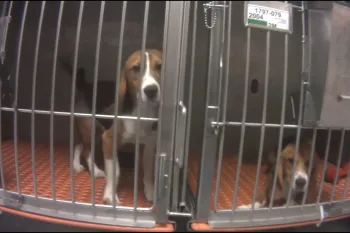
In no arena of animal-related concern has the Trump administration better distinguished itself than the drive to reduce and eliminate animal experiments. This is a complex scientific issue and a management challenge encompassing multiple agencies. Time will tell, but the public statements of Secretary of Health and Human Services Robert F. Kennedy, Jr., National Institutes of Health Director Jay Bhattacharya, Food and Drug Administration Director Marty Makary, and Environmental Protection Agency Administrator Lee Zeldin have been encouraging. And some initial steps suggest a commitment to following through on these sentiments.
These leaders, along with key administrators at their agencies, recognize what we’ve been pointing out for years, that animal experiments not only cause immense suffering, but they do such a poor job of mimicking the human body that they’re actually hindering—not advancing—human health, and that we can and must take swift and decisive action to develop and implement non-animal technologies that can better meet our medical and public health needs.
Companion animals
Attorney General Pam Bondi and Secretary of Agriculture Brooke Rollins recently announced their commitment to multi-agency coordination to address dogfighting, puppy mills, crush videos and individual acts of abuse, among other concerns. Bondi intends to designate specialized prosecutors in every state to handle animal cruelty cases and to provide enhanced training in the execution of related search warrants.
For her part, Rollins promised the public there would be “no more puppy mills where you have puppies stacked on top of each other, where if you don’t sell them, then you drown them in a barrel because it’s the cheapest way to do it.” With puppy mills, the devil is in the details, and so we welcome the agency’s plan to upgrade its standards for the treatment of dogs in U.S. Department of Agriculture-regulated facilities, and to crack down on those that have evaded licensing and inspection requirements. We’ve been advocating for a definitive upgrade for several years now, and we’ll hold the administration to its word.
These expressions of concern lead directly to the Better Collaboration, Accountability, and Regulatory Enforcement (CARE) for Animals Act, a bill we strongly support. The Better CARE for Animals Act’s fundamental goal is to further strengthen cooperation between the Department of Justice and the USDA in Animal Welfare Act enforcement, and its passage would have implications for the protection of animals in puppy mills—as well as wild animals kept in captivity and animals kept in laboratories, among others.
Jo-Anne McArthur/Montreal SPCA / We Animals
Help pass critical legislation
The Better CARE for Animals Act will strengthen Animal Welfare Act enforcement. We must do more to end the unnecessary suffering of animals and act to save their lives before it is too late.
Wild animals
The administration’s record on wildlife issues is an exceedingly poor one. In November 2025, the U.S. Fish and Wildlife Service canceled the much-anticipated release of a National Recovery Plan for gray wolves, a critical conservation tool, stating that the animals no longer merit protection under the Endangered Species Act. This claim sets the stage for possible regulatory action to officially strip wolves of their remaining protections under the Endangered Species Act in 2026, if Congress doesn’t beat them to it. In December 2025, the House of Representatives passed a bill that would delist wolves and block judicial review of such an action, which is now awaiting action in the Senate.
Harry Eggens/
Stand up for wolves
Gray wolves continue to face ongoing threats to their survival. Tell your legislators to protect wolves and the Endangered Species Act.
Throughout 2025, the USFWS proposed a series of changes to the way the agency fulfills its responsibilities under the Endangered Species Act. One of the worst proposals included removing the definition of “harm” under the Act, which for decades has helped to defend against deadly habitat degradation. Also on the chopping block is the blanket 4(d) rule; without it, newly listed threatened species would by default receive no protection from being killed or hurt.
Other looming threats include orders to:
- Open additional federal lands administered by the Department of Interior (including some National Park Service lands) to hunting, putting more wildlife in the crosshairs and disadvantaging people who participate in other kinds of recreation like wildlife watching.
- Rescind a National Park Service regulation prohibiting bear baiting on Alaska’s national preserves.
- Rescind the 2001 “Roadless Rule” protecting tens of millions of acres of national forest land from road building and logging.
- Open certain wildlife refuges and terrestrial and marine national monuments to oil/gas development and commercial fishing.
The administration’s multi-pronged attacks on efforts to address climate change, including undermining enacted laws, regulations and projects already underway, will have severe impacts on wildlife.
There have been several exceptions to the pattern of bad policies regarding wildlife. One involves wildlife trafficking. Early in 2026, the House Natural Resources Committee held a well-attended subcommittee hearing on wildlife trafficking, and Brian Nesvik, director of the U.S. Fish and Wildlife Service, signaled that, in coordination with the DOJ, his agency intends to take wildlife trafficking seriously. We are also heartened by a proposal last summer to list seven additional species of pangolins—the world’s most trafficked mammal—under the Endangered Species Act.
We would welcome a change of course by the administration on most wildlife issues, knowing that millions of voters—of all political persuasions—support the wildlife protection agenda we’ve consistently championed: not only demonstrable progress on wildlife trafficking issues, but also strong endangered species protections, and especially the maintenance of a listing for wolves and grizzly bears under the Endangered Species Act.
Horses
For horse protection, 2025 was a bitterly disappointing year. The USDA delayed—three times—implementing changes to better defend horses against soring, a practice in which trainers use painful equipment and devices, burn them with chemicals, and perform other excruciating procedures to get them to perform the high-stepping gait known as the “Big Lick.” The delays stalled long-promised reforms to end industry self-policing and strengthen federal oversight, leaving these horses vulnerable to continued abuse.
And while America’s wild horses and burros are currently protected by annual appropriations riders from being sold to slaughter or killed outright by the Bureau of Land Management and the Forest Service, we must be vigilant to ensure the passage of those riders in every federal budget. Last spring the president’s budget request dropped this important protective language, though Congress thankfully did include it in the final legislation enacted for FY26.
Similarly, annual appropriations riders also protect domestic horses from being slaughtered for human consumption in the U.S. Horse slaughter is opposed by the vast majority of Americans and we’d like to see President Trump include a permanent ban on domestic horse slaughter in his FY27 budget request. It’s time for the government to adopt a permanent ban on this needless killing—and would be fitting in the Year of the Horse.
Farmed animals
In recent weeks, Agriculture Secretary Rollins has made public statements calling California’s historic law on farmed animal welfare, Proposition 12, “oppressive,” stating that it “cannot be allowed to continue.” We disagree on both points. The leaders at USDA and House Agriculture Committee Republicans are out of step with public opinion, with the sweeping passage of more than a dozen such laws in other states, and with the dramatic transformation taking place in the consumer marketplace and corporate supply chains regarding animal welfare. The president should put an end to the special interest politics playing out at the agency and in the House Agriculture Committee, where clearly Big Pork is calling the shots.
Konrad Lozinski/We Animals Media
Your voice is critical
The "Save Our Bacon Act" is bad for animals, consumers, and farmers. If it is enacted, hundreds of state laws protecting animals and addressing disease control, toxic materials, food labeling and more could be destroyed.
Similarly, special interests have led to two other substantive failures by the administration in respect to farm animals. The USDA’s announcement loosening slaughter line speed limits is a shocking giveaway to the pork and poultry industries—one that will betray animal welfare principles and compromise worker safety and food safety in the already horrific context of the modern American slaughter plant.
Big Pork’s heavy hand is also evident in the recent approval of a regressive set of dietary guidelines that go against most of the best nutrition science available. More meat and more dairy, and more full-fat dairy, are music to the ears of the factory farm operators who will most benefit from the government’s push for increased consumption of these products. Our dietary guidelines should serve the public interest, not fill the coffers of mass-production, low-welfare operations whose business model involves the denial of animals’ most basic needs and a disregard for the kind of food pyramid that would actually improve Americans’ health.
As if all of this weren’t enough, the federal government is also considering a rollback of the nation’s oldest animal welfare law, the Twenty-Eight Hour Law, passed in 1873, removing regulations that provide certain protections for animals in transit to slaughter.
—
Creating a better world for animals demands a clear-sighted vision of what is possible when people come together in defense of the voiceless. At a few federal agencies, key leaders understand this. At some of the others, they don’t. We don’t expect the president to mention our issues in his speech, but we do want to see him follow through on commitments showing animal welfare is a serious priority and reject the doublespeak and harmful policies that have perilous consequences for animals.
Kitty Block is president and CEO of Humane World for Animals. Follow Kitty Block on X. Sara Amundson is president of Humane World Action Fund.