Italy has taken a first step toward a future in which farmed animals are no longer confined in cages. In January, the 2026 Italian budget law went into effect, establishing the country’s first public fund dedicated to supporting the transition to cage-free animal farming systems.
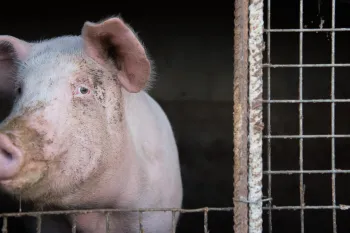
Cage-confinement deprives animals of the ability to express their natural behavior and often even the space to turn around, leading to higher stress levels and more frequent health problems. These animals spend all or most of their lives in barren cages designed to restrict their movement so they can hardly move a few inches in any direction.
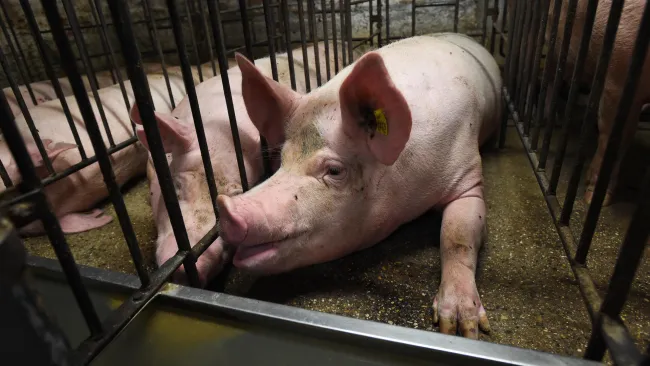
Jo-Anne McArthur/Essere Animali
In Italy, more than 40 million animals are still forced to live in cages on farms every year, including pregnant pigs, rabbits, calves, hens and quails. Across the European Union, the number stands at 300 million. And while the EU has already banned traditional battery cages for egg-laying hens, nearly 40% of hens used for egg production are still confined in so-called “enriched” cages, provided with around the space of a standard sheet of paper and denied the opportunity to fully express their natural behaviors such as dust bathing and perching on elevated roosts. The most recent scientific opinions of the European Food Safety Authority clearly recommend a transition to cage-free systems to improve their welfare.
According to the latest Eurobarometer survey, 91% of Italian citizens oppose the use of individual cages in the animal farming sector. At the EU level, as many as 1.4 million people have supported the “End the Cage Age” European Citizens’ Initiative, calling on the European Commission to phase out and ultimately prohibit the use of cages in EU farming. Together with the other members of the “End the Cage Age” coalition, Humane World for Animals is working to ensure that the Commission honors its commitment and submits a dedicated legislative proposal.
The measure was approved by the Italian Parliament, allocating €500,000 for 2026 and €1,000,000 for 2027 to support structural and management changes in industrial animal agriculture operations. While we were hoping for an even higher allocation, the creation of this fund is a starting point that sends an important political signal: Political parties came together, with the support of the Italian Minister of Agriculture, to create real change for farmed animals, which demonstrates a significant precedent at the EU Member State level.
We will work to ensure that the fund is maintained and expanded in the coming years and that other countries make similar tools available, especially as we expect there to be a comprehensive revision of the European Union’s animal welfare legislation soon.
Our global movement has made immense progress because we have built relationships and coalitions with the aim of creating a better world for animals, one that is more humane and more hopeful for future generations. To this end, we work with policymakers, corporations and public and private financial institutions around the world to improve policies, practices and procedures related to animal welfare.
If you too dream of a cage-free Europe and a more compassionate food system, speak up for animals suffering on factory farms and take action through your everyday food choices.
Kitty Block is president and CEO of Humane World for Animals. Follow Kitty Block.