
“Who am I?” reads the text from a friend in crisis. The timeless question—asked by every person at some time—still lacks a definitive answer, despite millennia of pursuit by philosophers, prophets, gurus and scientists. Furthermore, how we define ourselves differs from how others do, including the algorithms that feed our content streams daily.
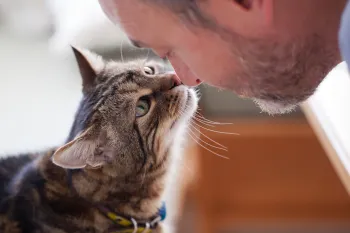
But perhaps we are barking up the wrong tree. Instead of seeking a human answer, we may look to other species—our pets. Cats and dogs, especially, observe us more closely than almost any human and can penetrate all facades to what lies beneath. As such, our furry companions may hold up the truest mirror of our nature, and recognizing that reflection can reveal much about ourselves and light a path to a better me. Here’s how.
FG Trade/Getty Images
Resources to help care for your pets and other animals
Find expert tips and trusted resources on pet care, animal behavior, humane wildlife management, and animal advocacy. Help animals live better lives with Humane World for Animals.
How our pets ‘see’ us
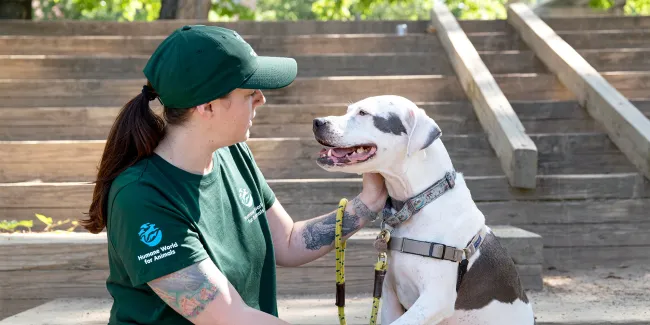
“You can’t hide almost anything from a dog,” says Dr. Nicholas Dodman, professor and program director of the Animal Behavior Department of Clinical Sciences at Tufts University. That’s because dogs are masters of reading human body language and have been doing so for 20,000 years of domestication.
They also bring a powerful tool—a nose with up to 300 million olfactory receptors that can capture us to the microbial level. Dogs analyze these aromas with similar power, too, thanks to an olfactory bulb in the brain 40 times larger than that of humans. Cats, the second most common pet in the United States, may not match that number but still have up to 200 million, miles ahead of humans' paltry 5 million or so. Though eyesight in dogs and cats may not be as powerful as their noses, it’s plenty sharp enough to understand body language. “They can read you like they’re reading a book,” Dodman says.
Meredith Lee/Humane World for Animals
These senses can convey a vast amount of information about us to them—sex, pheromones, hormones, adrenaline, heart rate, blood sugar and so much more. When combined with visual cues, such as pupil size, facial expression, eye contact, gait and stance, and body tension, dogs and cats gain a pretty clear picture of who a person is and their current emotional state. “They know almost everything about our emotions, from using vision and smell,” says Dodman.
Medical science has honed this sensory superpower in dogs to sniff out a variety of conditions and diseases, including diabetes, COVID-19, cancer, epilepsy and even narcolepsy. And even dogs not specially trained to seek and flag these can still register a difference.
Cats may not be able to match this acuity, but they still form attachment bonds that can tell them a lot about us. Studies show that cats can understand human emotional signals— detecting sadness, for example, through facial expressions, auditory cues and other behaviors. They can also distinguish personalities, as noted by Dr. John Bradshaw, a cat-behavior expert at the University of Bristol, in a National Geographic article. “They learn what works with what person,” for example, who tends to get up at 4 a.m. and give them treats.
The point is, our pets—more than anyone—know who we are.
Debunking the myth that pets can detect a “good” or “bad” person
Ironically, one thing pets can’t detect is something many caregivers believe they can: a person’s character. Nevertheless, the conviction remains strong and widespread, so much so that 72% of romantic relationships hang on a pet’s approval, according to one 2025 study by Rover.com.
Anthropomorphism fuels much of this belief, as it places the animal in a universe of human morals that they do not share or recognize. While the way someone interacts with an animal can provoke a negative—even aggressive—response, it’s not a judgment by the pet on the person’s innate trustworthiness.
“A lot of things that we do as humans, that we think of as being positive greeting for each other —like looking people in the eyes, reaching out to shake hands, those sorts of things—are actually considered threatening for dogs and cats,” notes Dr. Valli Parthasarathy, a veterinary behaviorist and co-founder of Synergy Veterinary Behavior.
There are also other reasons a cat or dog may react negatively to an individual that have nothing to do with their moral qualities. The person may have had a bad experience with a pet or breed (such as this writer’s mauling by a German shepherd when he was 11) that causes recoil on both sides.
A lot of things that we do as humans, that we think of as being positive greeting for each other are actually considered threatening for dogs and cats."
—Dr. Valli Parthasarathy, a veterinary behaviorist and co-founder of Synergy Veterinary Behavior.
The pet, too, may have specific triggers, such as white beards, baseball caps or loud noises. Dodman describes a case of a dog who was frightened of men with white beards. Further investigation about the animal’s past revealed that the dog had, in fact, had a bad experience with a man with a white beard.
Lastly, a pet’s judgment of good and bad in a person comes down to how they are treated by humans. “You might be a terrible person with one individual and a great person with your dog. That’s all your dog cares about,” explains Dr. Carlo Siracusa, professor of clinical small animal behavior and welfare at the University of Pennsylvania. Even the grouchiest humans are sometimes adored by their pets.
This lesson is one that Parthasarathy passes on regularly to clients. “One of the things that clients come to me for sometimes is like, ‘Hey, I want my dog to bark, but I only want them to bark at bad people.’ And my response usually is, ‘Well, they don't know who a bad person is.’”
Seeing our reflection in our pets
For caregivers, learning to read our pets better may not only help recognize and resolve issues in their fur babies—physical, emotional and mental—but also ones in themselves. In fact, Dodman points out, “About 15% of a dog’s behavior is linked to the human personality.”
A prime example of this is fear. “It’s absolutely, exclusively been shown that dogs can smell human fear,” explains Dodman. “If you feel frightened about a situation with your dog on lead, he’ll pick up on your fear and then act accordingly, so either shrink or come forward in terms of aggression.”
Parthasarathy sees this phenomenon too. “If a person acts nervous around a dog…then that dog might be a little bit put on edge of, ‘Why are you acting kind of weird? Maybe, if you’re acting weird, maybe I need to be nervous about you too.’”
Another manifestation of this is in the way dogs on leashes can respond to approaching ones. “When a person sees another dog approaching, they can tense up, and they can kind of stop breathing, and that tension travels down the leash to the dog,” Parthasarathy says. “So, the people may not actually realize it’s happening, but the dog can feel it.”

Emily Dewan Photography
Cats’ behavior may also reflect changes in the home environment, perhaps even more than dogs, says Siracusa. “One thing that cats really suffer from are changes in the environment, in the schedule, and they will start to lick themselves and have these alopecic areas without hair.” The death or departure of a caregiver, for example, might induce this behavior, perhaps revealing a need among the entire household to process and grieve.
Even without specialized training to detect disease signals, dogs may still recognize abnormalities in caregivers and respond. In the case of one client of Dodman’s, it was potentially lifesaving. “I didn’t notice it myself,” the man said, “but my dog came and kept paying attention to the region of my lower leg, around the calf muscle. He kept coming up to and sniffing it. I looked and saw this little black spot. So, I went to the doctor, and it was melanoma.” The dog wasn’t trained, Dodman adds, but “he just knew there was something different.”
Other manifestations of this natural ability might be a dog acting in certain ways before a caregiver has a seizure or when their blood sugar gets too low.
“If the pet is really fixated on a certain body part or seems to be paying attention to you in a way that’s abruptly different from the way they used to, and it seems to be pointed toward or indicative of something that is happening to you, then perhaps that would be something to have a conversation with your doctor about,” Parthasarathy suggests.
Pet therapy for self-improvement
On occasion, a pet may respond to caregiver issues in negative ways, which can be problematic enough to inspire a visit to a vet or behaviorist. While medication and other therapies for the distressed pet may alleviate the problem, still more might be achieved by the owner working on themselves.

Adene Sanchez/iStock.com
One thing Parthasarathy discusses with clients, for example, is trying to relax in ways that help the pet. “There are some clients where I have said, ‘Hey, when you are getting worried and acting anxious, I’m noticing that Fluffy is also acting a little bit anxious.’”
That same bond between the pet and caregiver also opens the doors to self-improvement on nearly every level. That’s because caring for a pet can grow and foster many positive human qualities.
Physically, dogs are the great exercise trainers, as they may require multiple daily walks that provide numerous benefits to the owner, too, helping them lose weight, improve cardiovascular health, and take in fresh air and sunshine. In fact, one study shows this amounts to 200 more minutes of exercise a week than people without dogs.
Perhaps the most powerful benefit to foster a better self is the unconditional love of cats and dogs, defrosting frozen hearts and growing grinch ones three sizes more. That alone spurs a host of positive reactions throughout the body, releasing dopamine, oxytocin and serotonin, which actually make you feel better. So, too, does petting your cat or dog, which decreases cortisol levels and blood pressure.

Photoboyko/iStock.com
Raising a pet also requires sacrifice, whether it’s that late-night emergency run to the vet or consoling a nervous pet during the fireworks. This not only fosters empathy, resilience and thoughtfulness but also provides a larger purpose to life—qualities essential to successful human-to-human relationships. Dogs, especially, can grow those further by connecting the caregiver with the wider community, as any dog walk or park demonstrates.
Another way pets can lead to a better answer to the question, “Who am I?” is through mindfulness. They live fully in the moment—literally stopping to smell the flowers—and can bring you there with them. That mindfulness can also inspire the acceptance of other people, an essential quality for long-term relationships. Siracusa concurs: “Respecting other individuals for who they are, not pretending they are who we want them to be. That’s definitely a very positive personal growth.”
A path to a better me
Perhaps no better example of the reflections between pet and caregiver is the uncanny physical resemblance that can appear over time—and often becomes social media fodder. However, those reflections may go much further than skin deep and carry a message for those ready, willing and able to read them.
Learning to do so doesn’t just benefit the pet, but also the caregivers, serving as a sort of intervention for issues they might not be fully aware of. For those in an existential crisis and unhappy with their reflection in the mirror, this communication may light the path to redemption—and reveal a way to a better me.
Michael Dunphy is a writer and editor for numerous publications, companies and schools. His articles have appeared in outlets like Forbes, National Geographic, USA Today, CNN and PBS. He also teaches writing courses at Gotham Writers Workshop.
Related stories
Rachel Stern/Humane World for Animals
Pets grieve too. Here's how to recognize the signs of animal grief and offer comfort and support your pet during loss.

Rachel Stern/Humane World for Animals
With lots of patience and veterinary support, we can help our pets lose weight and support them in living healthier, happier lives.
Rachel Stern/Humane World for Animals
Fostering animals can be an emotionally satisfying experience, but it also can cause stress. Here's how to care for your mental health while helping animals in need.