BRUSSELS—Humane World for Animals Europe (formerly called Humane Society International Europe) has just released The Pecking Order 2025, the third consecutive annual report evaluating chicken welfare policies and progress among major fast-food brands in Poland and Romania, alongside five other EU countries (France, Sweden, Denmark, Czechia, Italy). While the EU average score for chicken welfare rose to 26% in 2025, up from 22% in 2024, the results for Romania and Poland reveal a concerning downward trend. In Poland, the country's industry average fell to 16% in 2025, down from 18% in 2023, making it one of the lowest-scoring markets. In Romania, the country's industry average fell to 11% in 2025, down from 17% in 2023, making Romania the lowest-scoring market.
The report highlights a gap between corporate promises, consumer expectations and the cruel reality faced by millions of chickens in the food industry.
The findings show that fast-food chains need to urgently adopt better welfare standards for chickens in their supply chain, given the immense scale of the industry: in 2024, 6.7 billion chickens were slaughtered for meat in the EU, with 1.3 billion coming from Poland and 320 million from Romania, according to the Food and Agricultural Organization of the United Nations, 2025.
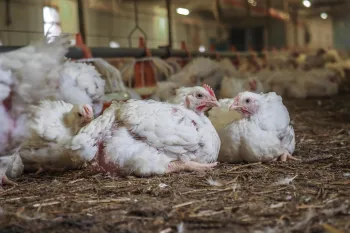
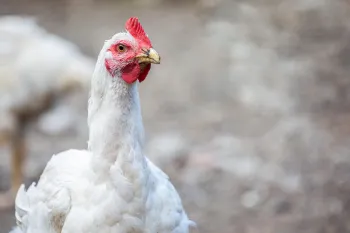
Approximately 90% of chickens raised for meat in the EU are confined in intensive indoor systems, in which tens of thousands of birds are packed into overcrowded barns, bred to grow so fast they commonly suffer from leg disorders and difficulty walking. These birds, known in the industry as “broilers”, are the most farmed land animals in the world. Yet outdated legislation still allows them to be raised in intensive systems, where they suffer from lameness due to unhealthy fast-growing breeding, overcrowding and cramped cages, barren environments and inhumane slaughter methods. To address the systemic issues involved, The Pecking Order report relies on the science-based criteria of the European Chicken Commitment, agreed upon by 38 animal welfare organisations worldwide. These criteria set minimum standards that address the most urgent welfare concerns in the production of chickens who are kept and killed for meat. The ranking is based on what companies publicly commit to and how they track their progress.
In Poland, The Pecking Order 2025 assesses 12 leading fast-food chains. Homeware chain IKEA leads the 2025 ranking with a strong ECC-aligned commitment, implementation reports and a clear roadmap with milestones. However, transparency on performance remains limited. Domino’s Pizza Poland has a strong chicken welfare policy and has publicly committed to improving chicken welfare by 2030. Pizza Hut ranks third, with a strong ECC commitment but no public reporting on implementation progress. Subway places fourth: the company had an ECC policy but is no longer fully aligned after removing its 2026 deadline. Kentucky Fried Chicken and McDonald’s have their own policies that don’t meet the basic animal welfare standards of the ECC or any progress reporting. The remaining brands (Burger King, Popeyes, Starbucks, Pasibus, Salad Story and Zahir Kebab) score between 0% and 1%, lacking any meaningful or time-bound commitments to improve chicken welfare.
In Romania, the 2025 edition also evaluated 12 leading fast-food chains and key findings reveal a significant disconnect between the global animal welfare commitments of the parent company and local implementation in Romania. Once again, IKEA tops the 2025 ranking due to its clear ECC commitment, implementation reporting and roadmap, although performance transparency is limited. Pizza Hut is second, showing strong commitment but lacking public implementation updates. Subway ranks third; its ECC policy is now partially aligned after dropping the 2026 deadline. Kentucky Fried Chicken has its own policy that doesn’t meet the basic animal welfare standards of the ECC, and the company lacks public progress reporting. The remaining international and national brands (Burger King, Domino’s Pizza, McDonald’s, Popeyes, Starbucks, 5 to go, Salad Box and Spartan) score between 0% and 1%, lacking any meaningful or time-bound commitments to improve chicken welfare.
Iga Głażewska-Bromant, country director of Humane World for Animals in Poland, says: “There is an urgent need for food companies operating in the Polish market to take further action and accelerate progress to improve animal welfare in their supply chains. The fast-food companies assessed in this report must take concrete steps to improve chicken welfare by adopting European Chicken Commitment standards and creating clear roadmaps to achieve their goals. The Pecking Order 2025 also highlights the need for stronger collaboration between fast-food chains and chicken farmers to implement a transition to higher welfare farming models, which may also help reduce reliance on antibiotics. Companies cannot ignore the growing consumer demand in Poland for better welfare. Recent surveys show that 88% of people in Poland expect higher welfare standards for animals and nearly 44% are willing to pay up to 20% more for products if it means improving chicken welfare.”
Andreea Roseti, country director of Humane World for Animals in Romania, says: “The animals are the ones who pay the price for poor welfare in the food industry when they are crammed into dark sheds and bred to grow so fast they can barely walk. Animal welfare is a major indicator of a responsible and resilient business. Disappointingly, for the third time in a row, The Pecking Order report shows the same troubling picture in Romania: lack of action from the fast-food industry, despite public demand for better animal welfare. The Romanian fast-food industry must take responsibility and act now by adhering to European Chicken Commitment standards. We invite all leaders from the food industry to reach out to Humane World for Animals, so that we can work together to improve animal welfare in their supply chains.”
Intensive chicken farming not only causes systemic animal suffering, it is also a substantive public health matter. The misuse and overuse of antibiotics to enhance growth and prevent diseases have contributed to antibiotic-resistant bacteria, impacting animal welfare and human health. The ECC promotes the transition to healthier breeds who have improved immunity, fewer leg issues and require fewer antibiotics. The commitment also requires lower stocking densities, which are proven to improve animal welfare, while having the potential to reduce the need for antibiotics.
The Pecking Order serves as a tool for progress, offering actionable steps for fast-food companies, farmers and lawmakers, to take responsibility and drive meaningful change.
Fast facts:
- The European 2025 edition of The Pecking Order is a project by World Animal Protection, together with Humane World for Animals, Essere Animali and Obranci Zvirat. A total of 81 companies were assessed in 2025 covering the markets of Czechia, Denmark, France, Italy, Poland, Romania and Sweden.
- The Pecking Order has assessed fast-food brands since 2019. In 2025, the report examined seven European markets, and Poland and Romania were included for the third time.
- There is an EU-wide increase in scores. The EU average rose to 26% in 2025, up from 22% in 2024. French and Swedish fast-food companies lead with a 42% and 40% average score respectively. Polish and Romanian food chains have the lowest scores of 16% and 11% respectively, indicating a need for more attention to chicken welfare.
- The reports are available at:
Humane World for Animals works globally to persuade corporations, financial institutions, food service companies, governments and farmers to eliminate the worst practices of industrial animal agriculture that subject the greatest number of animals to the longest duration of suffering, including intensive confinement. While our work is global, we have farmed animal welfare teams in Australia, Brazil, Canada, Chile, the European Union, India, Malaysia, Mexico, South Africa, Thailand, the United Kingdom, the United States and Viet Nam. We also promote a shift toward a more plant-forward, climate-friendly global food system by providing culinary resources and training to institutions serving millions of meals daily and advocating for policy change at national and international levels.