
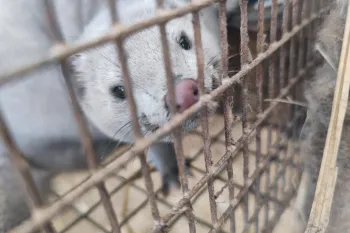
ROME—Humane World for Animals Italy (formerly called Humane Society International) welcomes the submission of new parliamentary questions, in both the Italian Chamber of Deputies and the Senate, regarding the fate of mink still confined in cages that were once used as fur farms in the country.
The two questions—signed respectively by Deputies Costa, Evi, Dori, Ascari, Caramiello, Cherchi, Di Lauro, D’Orso, Furfaro, Prestipino, Romeo, Bonelli, Borrelli, Zanella, Zaratti and by Senators Bevilacqua, Bilotti, Lopreiato, Sironi, Damante, Licheri S., Mazzella, Naturale, De Cristofaro, Potenti, Floridia A., Malpezzi, Marton e Magni—follow the European Commission’s decision to include American mink in the list of invasive alien species of union-wide concern, which from 2027 will make it illegal to keep these animals within the European Union.
As Deputy Sergio Costa, currently a vice president in the Chamber of Deputies, states: “The recent inclusion of the American mink among invasive alien species at the European level confirms how necessary a change of course is: Italy must strongly support a European ban on fur farming and trade to protect public health, the environment and animal welfare. We cannot allow opacity and administrative inertia to continue slowing down a transition that citizens have been demanding for years.”
In Italy, breeding and killing animals for fur production has been prohibited for four years, thanks to an amendment to the 2022 Italian Budget Law, passed after a long campaign by Humane World for Animals Italy and other animal welfare organizations. Under these measures, the complete decommissioning of the fur farms was supposed to occur by 30 June 2022, with annual compensation of 3 million euros for 2022 and 2023, to be disbursed according to criteria set out in an implementing decree.
However, to date, the decommissioning has not been completed and there is a lack of clarity regarding whether or not breeders are still receiving funds for managing their facilities. Due to a failure to issue a second implementing decree which is necessary to allow the potential transfer of mink to accredited shelters, the animals have continued to languish under the same conditions at the farms, unable to express their natural behaviors and constantly exposed to the risk of infectious diseases.
Senator Dolores Bevilacqua states: “Almost four years after Italy’s ban on fur farming, it is unacceptable that mink are still being held in facilities that no longer have any legal legitimacy in our country. The failure to issue the implementing decree is creating a regulatory limbo that exposes the remaining animals to unjustifiable suffering and the country to preventable health risks.”
The Hon. Eleonora Evi adds: “It is unacceptable that, nearly four years after the total ban on fur farming—including temporary exemptions—we still have to seek answers through a parliamentary question to the Government about the fate of the minks still confined in those cages: how many there are, and why the necessary decrees to release them and place them in the care of facilities and associations are still missing. It is deeply concerning that we do not know whether—and how much—public money is still being spent on an activity that should belong to the past. And I would add that, on the eve of 2026, it is appalling that anyone can still have the audacity to wear clothing produced through such immense suffering. Our call to the Government is to listen to the many Italian and European citizens—and now also the European Commission—who are calling for an end to this barbarity, including by banning the placing on the market of fur products.”
The most recent outbreak of SARS-CoV-2 identified in an Italian mink fur farm led, in autumn 2024, to the killing of the 900 animals who were still confined within the facility, located in the province of Cremona.
In March 2025, the Italian Ministry of Health ordered the immediate eradication of SARS-CoV-2 infection in former mink farms, including the killing of all animals present at the affected sites. However, the procedures for carcass disposal remain unclear.
Responding to the situation as things stand, the Hon. Devis Dori says: “We want to know whether the ministers questioned intend to disclose the number of mink still confined, how many have been killed for health reasons, and whether or not public funds are still being granted to breeders despite the fur farming being in force.”
In light of this legal and health anomaly, as well as a serious risk to public health and the environment, Humane World for Animals joins the parliamentarians who submitted the questions, urging the responsible ministers to clarify the expected timelines for issuing the missing decree as well as confirming if the Government intends to support a European-wide ban on fur farming in the appropriate EU forums.
Martina Pluda, country director of Humane World for Animals Italy, concludes: “The success of the European Citizens’ Initiative ‘Fur Free Europe’, which gathered more than 1.5 million signatures, shows that European citizens want to see this chapter on fur cruelty closed. By March 2026, the European Commission will indicate how it intends to follow up on this request, and it is therefore important that member states such as Italy that have already banned fur farming, take the right stance. Breeding animals for fur fashion is not only unethical but also economically unsustainable, and it is time for animals and taxpayers to stop paying the price to keep a dying industry afloat.”
#
Download photos of Finnish mink fur farms HERE.
Notes:
- More than 6 million animals are still confined at nearly 1,200 fur farms in the European Union.
- In a scientific opinion published in July 2025, the European Food Safety Authority highlighted that the physical and psychological suffering endured by animals bred for their fur is entirely incompatible with modern animal welfare standards.
- Mink farming has been scientifically recognized as a sector capable of promoting the emergence of new pandemics. Implementing the necessary measures to prevent the transmission of zoonotic agents within the European Union would cost up to 211 million euros per year, according to a report published in October 2025.
- The same report—authored by economist Griffin Carpenter in collaboration with Eurogroup for Animals, Fur Free Alliance, FOUR PAWS, and Humane World for Animals—revealed that the environmental and health costs attributable to fur farming in the EU far exceed its added value.