
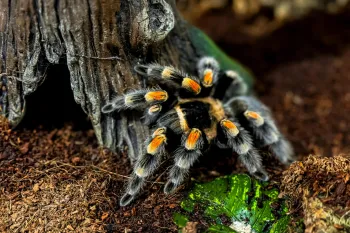
SAMARKAND, Uzbekistan—The overexploitation of Chilean rose tarantulas as wild pets will come under tighter regulations in future following protections against international trade being granted at the 20th Convention on International Trade in Endangered Species meeting.
Countries voted initially on Dec. 2 to reject the proposal to provide the Chilean rose tarantula and other look-alike species CITES Appendix II protections. However, the proposal discussions were subsequently reopened in plenary resulting in inclusion in Appendix II exclusively for the Chilean rose tarantula, which was adopted by consensus in recognition of their increasing illegal wild capture for international trade is negatively impacting wild populations.
Collection of tarantulas in huge quantities for the pet trade is threatening the survival of the species. Captive breeding to maturity (when individuals are most desirable as pets) is time-consuming and may not be cost effective, while mature individuals are easily collected from the wild. The Chilean rose tarantula’s territory is estimated to decrease by more than 30% in the next 18 years; this species could disappear from its habitat in the near future.
The Chilean rose tarantula is one of the most sought-after tarantula species. From 2016 to 2020, the United States imported or exported 20,317 specimens. Other main exporters are Chile, Germany, Netherlands, Switzerland, United States, Uruguay, Hungary, Poland, Paraguay and Canada. Shipments of smuggled tarantulas have been seized in Bolivia, Brazil, Chile, Colombia, Paraguay, Peru, Germany and the United States.
Grettel Delgadillo, director of program and policy at Humane World for Animals Costa Rica, formerly Humane Society International Latin America, said: “By including the Chilean rose tarantula in Appendix II, a message has been sent that it is time to end the overexploitation of and illegal pet trade in these beautiful spiders. It is very sad that due to their coloring, these tarantulas are very easy for wildlife traffickers to spot and capture to sell to pet traders, leaving behind a significant decline in their population due to their slow reproduction rate.”
Quick facts
- The tarantula proposal was put forward by Argentina, Bolivia and Panama.
- The natural habitat of the Chilean rose tarantula is the high desert regions of northern Chile, Bolivia, and Argentina.
- Chilean rose tarantula are venomous spiders, whose venom is injected into prey through their fangs. Although not extremely dangerous to humans, the venom contains neurotoxins that disrupt the nervous system.
- CITES offers three levels of protection for species affected by international trade:
- Appendix I is for species threatened with extinction because of trade, and more or less prevents commercial international trade except in exceptional circumstances.
- Appendix II allows trade under special conditions and is for species which may become threatened with extinction unless trade is subject to strict regulation. Appendix II controls include permit requirements and a science-based determination that the export will not negatively affect a species’ long-term survival in the wild (called a non-detriment finding).
- Appendix III is for species protected in at least one country, which has requested help from other CITES Parties to control trade in those species.