
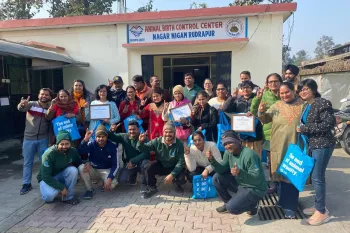
Rudrapur, Uttarakhand—As ongoing deliberations in the Supreme Court continue to draw national attention to humane dog population management, Rudrapur’s achievement demonstrates what science-based, humane interventions can achieve. In a record-breaking 19-month period, teams from Humane World for Animals India, in collaboration with the Rudrapur Nagar Nigam, have sterilized and vaccinated 95.3% of the city’s street dog population, approximately 5,500 dogs, according to a third-party survey. This figure significantly exceeds the 80% target outlined in the program’s Memorandum of Understanding (MoU), and now, formal control of the program will transition to the city’s government.
Launched in 2024, Rudrapur’s Animal Birth Control (ABC) program focused on reducing human–dog conflict, rabies risk and the birth of unwanted puppies, in alignment with Humane World for Animals’ broader mission of promoting humane street dog population management across India.
“Rudrapur is an excellent example of what can be achieved when a city chooses compassion over conflict and prevention over reaction. Effective planning, zero compromise on protocol and adherence to standard operating procedures have enabled us to achieve this target in just 19 months, six months earlier than the deadline,” said Dr Piyush Patel, director of Humane World for Animals India’s street dog program. “Without sustained ABC, any short-term intervention merely resets the problem rather than solving it. ABC, when implemented correctly, systematically and with transparency, will yield outcomes and reduce the dog population. The results won’t appear overnight, but they are assured.”
Strong community participation played a critical role in the program’s success. As the organization’s summary report indicates, approximately 800 dogs (17%) were caught and treated with the active support and participation of community members. This confirms the growing public trust and collaboration that informed citizen engagement creates, engagement that is essential to effective street dog population management.
Alongside surgical interventions, awareness and education formed a core part of the program. The team addressed nearly 300 citizen queries related to dog bite incidents, suspected rabies cases and relocation requests. Community outreach included school programs on safe human–dog interactions, education on legal frameworks and training in standard procedures for handling suspected rabies cases.
Responding to direction from the Uttarakhand Animal Welfare Board, an evaluation of the program at 21 different localities of the city was led. This survey, said Dr Ashutosh Joshi, chief veterinary officer of Uddham Nagar, confirmed that “95.31% of the stray dog population in the city has been surgically spayed or neutered, de-wormed and vaccinated against rabies as per ABC Rules.”
Facts:
Working closely with local communities and municipal authorities, Humane World for Animals India has successfully implemented a high-coverage ABC program across multiple Indian cities.
- In Uttarakhand, apart from Rudrapur, 89% of the entire dog population in Dehradun, 99% in Nainital, and 92% of the dog population in Mussoorie have been sterilized.
- An estimated 75 million dogs live on the streets in communities across India. Most puppies born on the streets die before they reach 12 months of age.
- Without access to veterinary care, dogs can die of rabies and other diseases and be forced to live with painful and debilitating injuries that could have been addressed through treatment.
- When the number of dogs exceeds a community’s capacity to care for them, street dogs can also suffer from malnutrition and may even face cruel behavior such as stone throwing, which can be exacerbated by a community’s fear of dog bites and rabies.
#