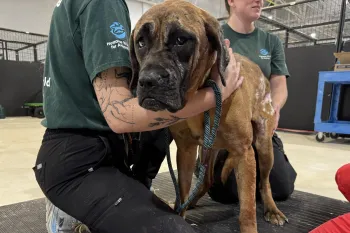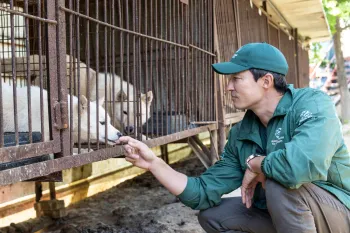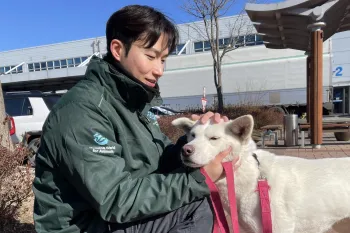
SEOUL—Sixteen dogs rescued from a dog meat farm in Cheongju, South Korea, last year have flown to Canada seeking adoptive homes. Their adoption journey coincides with a growing shift in public sentiment in South Korea as the country prepares to enforce its national dog meat ban in February 2027. New survey data commissioned by Humane World for Animals Korea reveals overwhelming public support for ending dog meat consumption, with 90% of respondents saying they do not plan to eat dog meat in the future, regardless of whether they had consumed it before.
Stella, Butter, Cream, Sugar, Bean, Oak, Daisy, Bella, Stone, Luna, Archie, Ghost, Benny, Lily, Cody, Jack and Shadow wereamong almost 70 dogs rescued by Humane World for Animals Korea, with help from actor Daniel Henney, after the farm was shut down by authorities for illegal slaughter violations. The puppies were too young to fly at the time of rescue but are now relocating to the charity’s care and rehabilitation center in Canada where they begin their journey to find families to adopt them.
Their journey has special significance. As there is no official rescue component to the Dog Meat Ban Special Act, relatively few dogs from the dog meat farms being closed during the phase out period have the opportunity to be rescued and adopted. According to the Ministry of Agriculture, Food and Rural Affairs, as of December 2025, 78% of dog farms have now closed which means South Korea is on target to achieve full closure by February 2027.
Key survey findings:
- 90% of respondents said they do not plan to eat dog meat in the future, regardless of whether they had consumed it before.
- Among those who have eaten dog meat previously, 74% said they have not eaten dog meat in the past year.
- 93% of respondents said they plan to stop eating dog meat or significantly reduce consumption after learning about the Special Act to End the Dog Meat Industry.
- 40% of those who had consumed dog meat did so due to social pressure, rather than personal preference.
- Nearly half of respondents said the government should take a more active role in rescuing dogs from meat farms.
Sangkyung Lee, campaign manager at Humane World for Animals Korea, said: “Our new survey shows there is strong public support for and compliance with the end of dog meat consumption in South Korea. The public also clearly expects the government to take more responsibility for rescue efforts. As we wave goodbye and good luck to the 16 rescued dogs on their adoption journey, it is sad to think that so many more beautiful dogs just like them could have had a chance of a happy life if only the government had proactively supported rescue. Even now on dog meat farms, puppies are still being born simply to be killed. The dog meat ban is an historic and progressive achievement, however our survey findings show the public believes a ban is not enough if it is not also combined with meaningful government action to rescue and protect these dogs.”
Upon arrival in Canada, all 16 dogs will receive additional care and support at Humane World for Animals’ facilities before being transferred to partner shelters for adoption. Several dogs from this farm rescue who were transported overseas in 2025 have already been adopted by families in the United States and Canada, embracing new lives under names such as Friend, Peach and Kiwi.
Since January 2015, Humane World for Animals has rescued almost 2,800 dogs from South Korea’s dog meat farms. Humane World for Animals works across Asia to end the dog and cat meat trade. In South Korea, Viet Nam, Indonesia, China and India, we pursue change through legislation, community engagement, animal rescue, rabies vaccination and livelihood transition programs, working both directly and with local partners.
Download photos and videos of the dogs here
Humane World for Animals’ rescues are conducted in compliance with national and local health and safety protocols including evaluation by a veterinarian and vaccination against rabies, distemper, hepatitis, parvo virus, parainfluenza, leptospira and canine influenza, as well as screening for respiratory illness as needed to ensure the health of each animal and comply with international export and import requirements.