
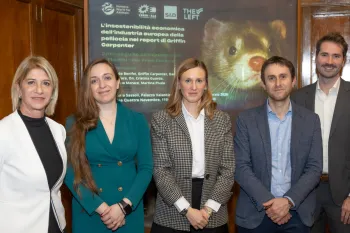
ROME—“It is time to put an end to fur farming and to the trade in fur products in Europe,” urged animal protection organization Humane World for Animals (formerly called Humane Society International) at today’s event “The economic unsustainability of the European fur industry,” held in Rome. The event was attended by Italian Members of the European Parliament Cristina Guarda (Greens/EFA), Carolina Morace (The Left) and Brando Benifei (Progressive Alliance of Socialists and Democrats) and by Roman city councilor Daniele Diaco (Five Star Movement). Some 53 Members of the European Parliament joined MEPs Guarda, Benifei and Morace in signing an open letter to Olivér Várhelyi, European commissioner for animal welfare, reminding him to respect the will of more than 1.5 million citizens who supported the Fur Free Europe European Citizens’ Initiative and who are expecting a positive response by March on the implementation of an EU-wide ban.
“Forcing wild animals such as foxes, chinchillas and mink to live in cages for their entire lives is not only ethically unacceptable, but also a threat to public health. We call on Commissioner Várhelyi to commit to protecting animal welfare and citizens’ health by putting an end to the waste of public funds that keep afloat an industry already in decline, one that designers and consumers are rapidly turning away from. As Vice-Chair of the European Parliament’s Committee on Petitions, I will work to ensure that the voices of the citizens who signed the ECI are heard,” says MEP Cristina Guarda.
In their letter, the MEPs expressed their concern about the ethical, environmental and public health issues directly associated with the EU fur industry. They also underscored its economic unsustainability.
In his report “A full-cost account of the EU fur industry”, which he discussed during the event, economist Griffin Carpenter explores how the fur farming sector in the European Union has been operating at a loss for years and is no longer economically viable without external funding. Moreover, it has such severe environmental and public health impacts that it generates additional costs borne by taxpayers, as Carpenter’s analysis demonstrates.
“The industry produces a gross value added (GVA) of -€9.2 million, thus contributing negatively, rather than positively, to the EU economy. Environmental costs (€226 million) and health costs (€211 million) exceed the sector’s total revenues (€183 million), resulting in an overall economic contribution, after subtracting these costs from the GVA, of -€446 million,” the economist explains.
“The fur industry today accounts for less than 0.003% of employment in the European Union, confirming it as a marginal sector with no future prospects,” adds MEP Carolina Morace. “For this reason, it is necessary to introduce an EU-wide ban, accompanied by an adequate phase-out period to ensure a fair transition for the few operators still involved. It is important that Italy, which has already had a ban in place since 2022, supports this position with the Commission and in the appropriate EU forums, starting with the Agriculture and Fisheries Council.”
Currently, national bans on fur farming exist in Austria, Belgium, Bulgaria, Croatia, Estonia, France, Ireland, Italy, Latvia, Lithuania, Luxembourg, Malta, the Netherlands, Poland, the Czech Republic, Romania, Slovakia and Slovenia. Other countries have introduced species-specific bans or strict regulations that have effectively curtailed the practice.
“Many Member States, including Italy, have already banned fur farming in response to a clear public mandate. It is now essential to uphold this direction and safeguard the European internal market from current regulatory fragmentation. For this reason, the next step at the EU level is indispensable: the introduction of a definitive ban on fur farming and the trade in fur products. The Union has already recognized the legitimacy of such an approach, particularly through the ban on products made from dog, cat, and seal fur,” says MEP Brando Benifei.
Pending action at the European level and with reference to the European Citizens’ Initiative, as well as to the Italian Constitution and the current national ban, city councilors Daniele Diaco, Paolo Ferrara and Linda Meleo have tabled a motion before the Rome City Council proposing the introduction of a ban on the display of fur and fur products derived from animals in shop windows across the municipal territory. The proposal is based on the competences of the Roman Municipality in the areas of animal protection, environmental protection, urban decorum and the promotion of public health. As stated in the motion’s preamble: “The display of fur or products containing fur may be perceived as contrary to public sensitivity and to the Capitoline values of animal protection, as well as to the environmental sustainability and urban decorum promoted by Roma Capitale.”
“I would like to thank the MEPs and the city councilors for their valuable and concrete support at all legislative levels and for listening to civil society. Citizens who wish to make their voices heard again can also sign an open letter to Commissioner Várhelyi: nearly 50,000 people have already done so,” concludes Martina Pluda, country director at Humane World for Animals Italy. “The European Commission has a unique opportunity to drive change, align policy with science and the shared values of its citizens, and usher in a new era that places ethics, the environment and public health at the center of this issue—leaving fur farming behind in the history books.”
At the event, Humane World for Animals screened the previously unreleased short film Stop!, produced in collaboration with the creative agency Human, which highlights the cruelty of the fur industry through the eyes of a mink.
Humane World for Animals works across the globe to end the fur trade. With a focus on the UK, Europe, North America and China, the organization’s work includes government, industry and corporate campaigns, collaborations with designers and fashion brands, undercover investigations and education campaigns, and has led to a steadily decreasing number of animals affected by this cruel trade.
#
Download photos from the event and the executive summary of Griffin Carpenter’s report (supported by Humane World for Animals, Four Paws, Eurogroup for Animals and the Fur Free Alliance) here.
Notes:
- The most recent data, from 2024, showed that more than 6 million animals were still confined at nearly 1,200 fur farms in the European Union.
- In a scientific opinion published in July 2025, the European Food Safety Authority highlighted that the physical and psychological suffering endured by animals bred for their fur is entirely incompatible with modern animal welfare standards.
- Fur production has a significant environmental impact. Animals are raised for several months before being killed, requiring continuous feed supply, housing facilities, and the management of waste generated throughout their lifecycle.
- Several zoonotic pathogens have been linked to fur farming, including SARS-CoV-2, influenza viruses, Salmonella, Campylobacter, antibiotic-resistant bacteria, and Cryptosporidium.
- More than 1,600 brands and retailers worldwide have committed to going fur-free. Other fashion industry players, such as Condé Nast and Hearst Magazines, have also adopted fur-free policies.