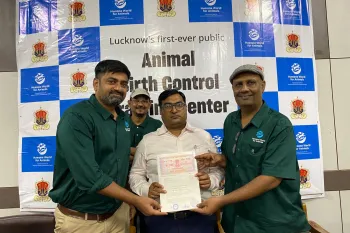

DEHRADUN, Uttarakhand—Humane World for Animals India (formerly Humane Society International India) celebrated a milestone in community-led street dog welfare and positive behavioral change initiatives, as 297 residential societies in Dehradun were recognized as ‘Abhay Sankalp Societies’ for formally assuming responsibility for humane, responsible, and compassionate dog-human coexistence programs in their communities. This means the community members in these societies have actively undertaken on-ground measures such as dog sterilization, regular vaccinations, dog behavior and rabies awareness, and regularly maintain designated feeding and watering points.
To celebrate this milestone residents, government officials, volunteers and leaders came ame together to acknowledge the grassroots efforts undertaken by these nearly 300 societies in areas like Pitamberpur, Tagore Colony, Anshal Green Valley, Aman Vihar and more. Since 2019, of 52,700 street dogs sterilized and vaccinated in Dehradun, 9,800 (18.6%) were possible due to the active involvement of members of local communities.
At the event, Dalia Jacob, senior manager of community engagement at Humane World for Animals India, said: “The celebration is not about any single program but about the community itself stepping forward. The most significant achievement has been the behavioral shift among residents—from viewing free-roaming dogs as a challenge to recognizing them as a shared community responsibility. The organization is proud to recognize housing societies that have consistently demonstrated compassion, responsibility and long-term commitment, noting that this collective change in mindset is what has truly transformed Dehradun into a safe city for both humans and dogs.”
Poonam Kaushik, a community member from Sangam Viah Abhay Sankalp Society said, “What I’ve seen over the last year is incredible. At first, most of us didn’t really know how to deal with the street dogs around us. There was hesitation, sometimes even fear. But once we started learning about their behavior and taking small steps together - like feeding them in one place, getting them vaccinated, and helping them during emergencies - everything changed. The dogs became calmer, the neighborhood became safer, and we, as residents, became more confident. Today, it truly feels like a shared responsibility. We’ve realized that when we care for them, they naturally become a peaceful part of our community.”
Since 2016, Humane World for Animals India has been working in Dehradun in collaboration with the Dehradun Municipal Corporation to foster human-dog coexistence and advance humane street dog management. With decades of community engagement, Abhay Sankalp has undergone a significant transformation: from a community beneficiary program to a community-driven movement. Communities are now working with us as equal partners, eventually becoming owners of their own safety development priorities. As owners, communities are identifying and executing humane solutions to manage dog populations. Abhay Sankalp is a powerful example of community-driven change in action.
What to know:
‘Abhay Sankalp’ (which means a resolution to be free from fear) focuses on bringing in people’s participation, building local community members’ capacity to be first responders to conflict and care while creating a network of local resources for animal welfare that are sustainable.
Since 2018, this program has been led by 600 societies, which includes 7,900 community members who took part in on-ground meetings focused on Animal Birth Control initiatives, conflict resolution and rabies prevention.
An Abhay Sankalp community is a society where:
- Residents understand general dog behavior.
- Residents provide designated and hygienic feeding and water spots.
- Residents work toward humanely resolving human-dog conflicts.
- ll dogs are vaccinated against rabies and sterilized periodically.
- All dogs are accounted for by the community.
- Residents will not relocate street dogs.
- Residents will be responsible pet owners.
- Residents are aware of laws governing free-roaming dogs.
- Volunteers attend to dog injuries and get veterinary intervention when needed.