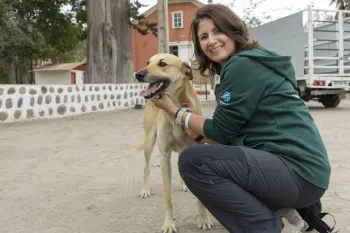
OVALLE, Chile—The cats and dogs of some of northern Chile’s most rural and underserved communities are receiving free veterinary examinations, spay and neuter services, vaccinations and health checkups thanks to a new welfare program launched by Humane World for Animals Chile.
A team of 18 specialists from the animal organization and its partners travelled to communities in Barraza, Salala and Oruro in the Coquimbo region where limited access to veterinary services can mean that animals go untreated for illness or injury, unvaccinated for preventable diseases, and that unwanted litters are born on the streets. While local residents care very much about the welfare of their companion animals, the nearest veterinary clinic is approximately a 40-minute drive by car or public transport. This absence of services is one of the most visible expressions of historical neglect that impact the people and animals living in these “forgotten communities” and many of the animals in the region will experience no veterinary care at all during their lifetime.
That’s changing now, thanks to this initiative.
Humane World for Animals’ local and international staff and volunteers worked side by side with veterinary professionals and students from the University of Chile on a four-day outreach effort to assess the region’s dog and cat populations, speak with community members about their needs, and operate a two-day mobile veterinary clinic providing vaccinations, deworming and basic wellness services to approximately 80 dogs and cats.
Magdalena Hernandez, Humane World for Animals Chile’s program manager of Companion Animals and Engagement, said: “Without accessible veterinary services, it’s a real challenge for the people in these communities to get their animals the care they need. Many residents don’t have their own vehicles to drive to the nearest clinic, and taking large dogs or multiple animals on a public bus is too challenging. So, with our new program bringing veterinary services to the heart of their communities, the people here can care for their companion animals in the way they have always hoped to do. This is just the beginning. We expect our work here to become the starting point of a working model that can be replicated around the world by us and others to ensure that remote locations are no longer a barrier to life-saving animal welfare. Animals are at the heart of our lives and improving their welfare means strengthening our communities as a whole.”
Humane World for Animals Chile’s veterinary intervention model for highly vulnerable communities begins with a robust community assessment to inform program design, guide decision-making and enable long-term impact measurement. The data collected provides essential insights into the community’s knowledge, attitudes and practices related to companion animal care, along with a population count of street dogs and cats.
Professor Constanza Cabello from the University of Chile’s veterinary faculty, along with six veterinary students and additional volunteers, provided vital support for the field program which included hands-on veterinary training for students, local capacity-building efforts and professional development for those involved in community-based animal welfare.
During the week, representatives from the regional government’s Department of Responsible Pet Ownership and the Municipality of Ovalle observed the field work, reinforcing coordination with local and regional authorities.
For their part, community leaders highlighted the importance of a sustained veterinary presence in historically underserved areas. Mrs. Maria Inés Villega Vegas, a resident of Barraza, said: “You no longer see sick cats on the streets, and people are very grateful for the help Humane World for Animals is bringing to the animals.”
This initiative focuses on “forgotten communities,” where access to veterinary care is limited, and animals often remain invisible. Through a comprehensive and collaborative approach, Humane World for Animals seeks to improve animal welfare, strengthen local networks and promote a culture of responsible, community-based animal care in rural northern Chile.
Humane World for Animals, formerly called Humane Society International, works across the globe to improve the welfare of street, community and companion dogs and cats. We promote humane, sustainable approaches to reduce street animal populations and support peaceful coexistence with people, offering solutions in place of lethal or inhumane methods. In addition to increasing access to care for companion animals in underserved communities, we also help people care for their animals and prevent cruelty and abandonment. This work is advanced in North America and countries including South Africa, Mexico, India, Chile, Costa Rica, Romania and Bolivia.
#