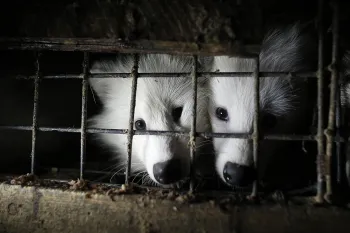
WARSAW― Poland has today become the 18th country in the European Union to ban fur farming, after President Karol Nawrocki officially signed a ban into law. This has been welcomed as ”an historic moment for animal protection in Poland” by Humane World for Animals Europe (formerly Humane Society International Europe) as Poland is the largest fur-producing country in Europe, second globally only to China, raising and killing around 3 million mink, fox, raccoon dog and chinchilla for fur annually.
The ban was achieved following approval in the Sejm (lower house of Parliament) and Senate last month and cross-party political agreement. It comes weeks after a damning report by the European Food Safety Authority concluded that animal suffering is systemic on fur farms and keeping animals for their whole lives in small barren wire cages cannot meet basic animal welfare needs. This report was requested by the European Commission in the wake of a Fur Free Europe ECI petition signed by 1.5 million EU citizens which called for an EU-wide fur farming and sales ban, to which the Commission will publish its official legislative policy response by March 2026.
Iga Głażewska-Bromant, Poland director at Humane World for Animals Europe, welcomed the ban, saying : "This is an historic moment for animal protection in Poland that will end the suffering and death of millions of animals kept on fur farms. Fur farming is not part of Polish heritage and most Poles oppose fur cruelty, as evidenced by opinion polls and the more than 76,000 petition signatures we recently submitted to the office of President Nawrocki. Today, we can proudly say that Poland becomes the 18th country in the European Union to introduce a ban on fur farming and we hope this will be a crucial catalyst for change as the European Commission considers the case for banning fur farming EU-wide."
Poland’s ban further isolates the last few remaining Member States that still allow fur farming―notably Finland, Denmark, Spain, Hungary and Greece. More than 6 million animals are kept on almost 1,200 fur farms across the EU, but the practice is now fully or partially restricted in 24 Member States—now including Poland—with the other bans implemented most recently in Romania (2024) and Lithuania (2023).
The fur farming ban will go into effect 14 days after its publication in the legislature, from which point no new fur farms can be established. Poland’s existing 200 fur farms have until January 2034 to close, although many are expected to stop business earlier than that due to compensation being offered to those closing within the first five years of the ban. The earlier that fur farmers apply for compensation and close their farms, the higher the amount paid.
Polish groups Otwarte Klatki and Viva! have been campaigning for a ban on fur farming in Poland for many years, and Humane World for Animals Europe has been pleased to work alongside them, including as a member of the Fur Free Alliance coalition.
Fur farming facts:
- Fur farming does not have a long tradition in Poland ; it wasn't until the second half of the 20th century that fur farms became established on a large scale.
- Fur farming poses a zoonotic disease risk. Mink on almost 500 fur farms across 13 countries in Europe and North America have been found to be infected with COVID-19, with millions of animals killed on public health grounds. Highly Pathogenic Avian Influenza A (H5N1) has also been found on 72 fur farms in Europe to date. Around 500,000 mink, arctic fox, red fox, raccoon dogs and sable were killed on public health grounds.
- Research shows that the carbon footprint of 1kg of mink fur is 31 times higher than cotton, 26 times higher than acrylic and 25 times higher than polyester. Raccoon dog fur and fox fur also have high carbon footprints, approximately 23 times worse for the climate than cotton and 18 times worse for the climate than polyester. Compared to other environmentally harmful forms of animal agriculture, the fur farming of carnivorous animals is worse.
- Fur farming is financially unviable. A recent full-cost analysis by a leading environmental economist demonstrates that fur farming is costing EU citizens as much as €446 million annually.
- Most leading designers have fur-free policies, including Max Mara, Saint Laurent, Gucci, Alexander McQueen, Balenciaga, Valentino, Prada, Armani, Versace, Michael Kors, Jimmy Choo, DKNY, Burberry and Chanel. Over 1,600 fashion brands and retailers worldwide have committed to being fur-free and as fur becomes increasingly unmarketable and ethically indefensible. Instead, fashion houses are choosing to innovate with sustainable, cruelty-free alternatives.
Watch video of Polish fur farms HERE and download photos HERE (visuals courtesy of Owarte Klatki).
ENDS