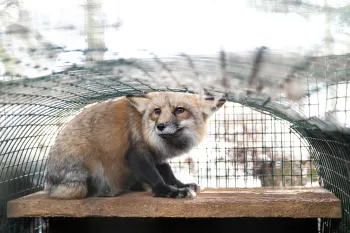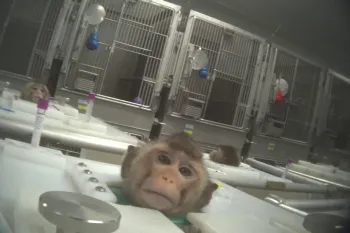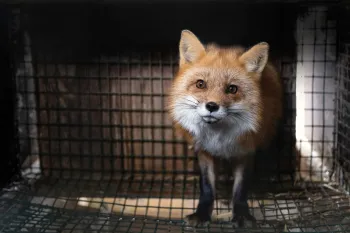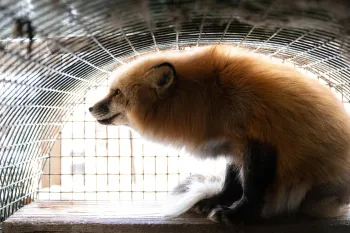
One year ago, Humane World for Animals, formerly called the Humane Society of the United States, completed the weeks-long rescue of hundreds of animals from a fur and urine farm near Cleveland, Ohio. A newly released Humane World for Animals documentary showcases the animals’ incredible journey against the backdrop of the cruel fur and urine industry. The survivors are now thriving, thanks to more than 40 wildlife rehabilitators, sanctuaries and other facilities across 15 states that provided temporary and permanent placement to the animals.
The rescue operation was initiated in late December 2024, when the Ashtabula County Commissioner’s Office requested the assistance of Humane World for Animals after the owner of Grand River Fur Exchange died, escalating an already-dire animal welfare crisis on the property.
Humane World for Animals responders found foxes, raccoons, wolf-dog hybrids, skunks, opossums and coyotes living in filthy wire-bottom cages with little to no protection from the frigid conditions. Some animals had missing toes, ears, tails and limbs, likely caused by a combination of their living conditions, proximity to other wild animals or being captured in excruciating leghold traps. Many were emaciated and severely dehydrated, and several animals were deceased, covered in snow and frozen to their cages when responders arrived.
The animals were being raised and slaughtered for fur, bred for sale as exotic pets, and held captive for urine farming. As detailed in the documentary, predator urine is advertised for use in hunting, trapping, dog training and, ironically, as a “humane” wild animal deterrent for gardeners.
“The suffering and terror on that property was among the most horrific situations imaginable. It’s haunting, even after a year,” said Adam Parascandola, vice president of Humane World for Animals’ Animal Rescue Team. “Seeing the survivors recover and thrive has been incredibly healing. The foxes—once trapped in tiny, frozen cages awaiting a brutal end—now playing with each other in spacious habitats. The skunks, foraging in grass and exploring their new world. So many organizations stepped up and worked together to make this happen.”
"My heart still breaks thinking about the generations of animals who suffered and died at Grand River Fur Exchange. Their plight and the incredible resiliency of the survivors should inspire change,” said Mark Finneran, Ohio state director, Humane World for Animals. “It’s concerning that the state of Ohio has not taken action to fix the broken licensing system that allowed such wanton cruelty to slip through the cracks for years. The owner of this facility held a Commercial Propagating License, which was in good standing with the state until the day he died. Ohioans overwhelmingly oppose animal cruelty, and we need laws and regulations that reflect those values.”
More than 300 animals from the property were placed with wildlife facilities and sanctuaries, with Ohio wildlife officials managing the placement process.
Following the rescue operation, Humane World for Animals continued to support the animals by funding their veterinary treatment, transportation, enrichment supplies, food, and the construction of new and upgraded enclosures at the sanctuaries and facilities which the animals now call home. Among the dozens of organizations that opened their doors to help these animals, Wildlife Rescue and Rehabilitation, Inc. provided a permanent home to approximately 40 of the skunks, coyotes and foxes. (PHOTOS/B-ROLL)
Background on the fur trade
Animals in the fur trade suffer immensely, both in their daily lives and when they are killed, often with methods like gassing, anal electrocution or clubbing, which often result in slow, painful deaths and are commonly used on fur farms because they prevent damage to the pelt.
In the U.S., there are no federal regulations related to the welfare, care or slaughter of animals farmed for their fur. While Grand River Fur Exchange was licensed by the Ohio Department of Natural Resources, Ohio does not have laws or standards of care for fur farming or slaughter. In fact, New York’s ban on anal and genital electrocution of foxes is the only state-level law on fur farm welfare, aside from California’s prohibition on the sale of new fur products which took effect in 2023. Humane World for Animals is urging other states to follow their lead.
In Massachusetts, pending legislation (H.990/S.551) would end sales of new fur products from animals confined in fur factory farms. A similar bill (S.2221) was recently introduced in Rhode Island. In New York, A.3065 would clarify state law to ensure municipalities have the ability to prohibit the sale of new fur products. Across the U.S., 16 localities have implemented such measures.
As rescuers celebrate a happy ending for survivors of Grand River Fur Exchange, a sobering reality remains: Each year, tens of millions of animals are bred and killed to supply the fashion industry with fur coats, fur trim for hooded jackets, and fur pompoms used on hats, gloves, shoes and a range of other clothing and accessories. The public can play a critical role in helping the millions of animals languishing in similar circumstances by supporting legislation to protect these animals, committing to a fur-free wardrobe and avoiding purchasing predator urine.
#
Documentary: Behind the Coat & Rose: The dark link between fashion and flora