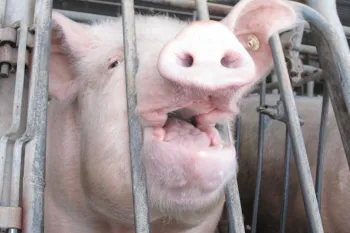
On Dec. 31, 2025, Ohio’s regulations limiting the use of extreme confinement for mother pigs in the pork industry will take effect. These rules mark a meaningful step forward for animal welfare in one of the United States’ top 10 pig-farming states.
“Farmers and industry leaders are shifting toward more humane housing for mother pigs, and we are encouraged that the Ohio agriculture community is taking a significant step away from extreme confinement systems. As Ohioans and Americans across the country agree, farm animals deserve the freedom to move,” said Kate Brindle, public and corporate policy program manager for farm animal protection at Humane World for Animals.
“Not only is confining animals in cages so small they can’t turn around inhumane, but it threatens to increase the spread of disease. Farmers and industry leaders are already shifting towards more humane housing for mother pigs, and Ohioans agree that farmed animals deserve the freedom to move. We’re proud that Ohio's regulations reflect those values by reducing the cruel confinement of these highly intelligent and curious animals,” says Mark Finneran, Ohio state director for Humane World for Animals.
Established in 2011, the standards provide that for the majority of a breeding pig’s pregnancy, she cannot be housed in a “gestation stall,” or “gestation crate,” metal cages barely larger than the animal’s body, severely limiting her movement. Ohio is one of 15 states that have laws addressing the extreme confinement of farm animals. These laws have strong, bipartisan support underscored by a study published last month that found 84% of U.S. adults believe confining mother pigs in gestation crates is unacceptable.
The American Public Health Association, the Infectious Diseases Society of America and the Center for Food Safety have stated that “[i]ntensive confinement prevents sows from moving freely and performing almost all natural behaviors, inducing high levels of stress. That stress triggers a physiological response that severely suppresses the sows’ immune function and that of their piglets, making the sows and their piglets more susceptible to disease.”
Major food corporations have been shifting toward higher animal welfare standards. Ohio-based Wendy’s and Kroger have enacted policies to house pregnant pigs in group housing systems. This is in addition to other fast-food restaurants like McDonald’s and Burger King, along with many retailers such as Costco and Safeway, which have adopted policies to source pork from group housing. Ohio farmers are at the forefront of meeting this demand.