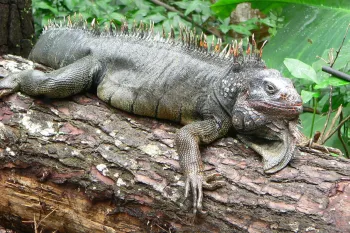
SAMARKAND, Uzbekistan― International trade in critically endangered Galápagos land iguanas and vulnerable marine iguanas has been banned at the 20th Convention on International Trade in Endangered Species meeting, to the relief of wildlife campaigners.
Populations of Galápagos land iguanas are declining fast, with estimates of as few as 5,000 to 10,000 individuals left. Hundreds of Galápagos land iguana hatchlings and juveniles are illegally traded domestically and internationally each year for the pet market. Illegal trafficking of marine iguanas is also a real concern, since the hatchlings and juveniles are indistinguishable from Galapagos land iguanas, making greater protections for both species a necessity.
Despite Ecuador—their only range state—having never authorized commercial export of live iguanas, international trade in 442 live individuals was reported between 1982 and 2023 for Uganda, Austria, Japan, Switzerland, Mali, Thailand, South Korea and India . As these iguanas are endemic to Ecuador, and there are no verified captive breeding programs outside Ecuador using legally acquired animals, this strongly suggests that this multi-country trade is driven by illegal sourcing for the pet market.
Grettel Delgadillo, director of program and policy at Humane World for Animals Costa Rica, said: “Uplisting from Appendix II to I is a critical step to protect these iconic species of iguanas from illegal trade and exploitation. The plight of the Galápagos land iguana exemplifies how widespread and insidious trafficking for the pet trade really is. This species is only found in Ecuador which does not authorize their export, and yet live animals are being caught and smuggled globally to feed the rapacious appetite for wild pets. This new CITES protection will help shut down a pet trade that should not even be happening in the first place.”
Other issues on the CITES agenda include proposals seeking to expand commercial trade in live elephants and their parts, reopening international commercial ivory markets; proposals to reopen commercial trade in stockpiles of white and black rhino horn from Namibia; and positive proposals to protect several species of gecko, sloth, rattlesnake and tarantula exploited for the pet trade.
Quick facts
- Both proposals were put forward by Ecuador to uplist from Appendix II to I: proposal 23 the Galápagos land iguana and Proposal 22 marine iguanas—both endemic.
- Ecuador is the only range state for these species; despite having never authorized commercial export of live iguanas, wildlife authorities have reported trade in live individuals from Austria to Japan, from Switzerland to Uganda, and from Uganda to Mali.
- In addition to illegal domestic and international trade, Galapagos lang iguanas are also vulnerable to predation of eggs and juveniles by undomesticated cats. This is exacerbated by the fact that land iguanas are an ageing population with 80% experiencing limited reproductive success. The species also contends with habitat destruction and death from volcanic eruptions.
- In addition to trade, marine iguana populations are also impacted by climate change, high mortality during El Nino events, and disturbance and injury from boat traffic, pollution and tourism.
- CITES offers three levels of protection for species affected by international trade:
- Appendix I is for species threatened with extinction because of trade, and more or less prevents commercial international trade except in exceptional circumstances.
- Appendix II allows trade under special conditions and is for species which may become threatened with extinction unless trade is subject to strict regulation. Appendix II controls include permit requirements and a science-based determination that the export will not negatively affect a species’ long-term survival in the wild (called a non-detriment finding).
- Appendix III is for species protected in at least one country, which has requested help from other CITES Parties to control trade in those species.
ENDS