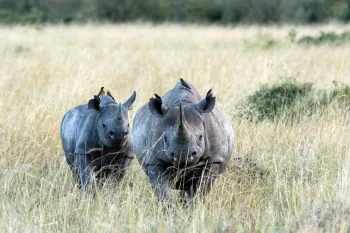
SAMARKAND, Uzbekistan― Wildlife experts at Humane World for Animals (formerly Humane Society International) are celebrating today as proposals by Namibia to significantly reduce protections against trade for the near threatened Southern white rhinoceros and the critically endangered black rhinoceros were rejected at the 20th UN Convention on International Trade in Endangered Species meeting.
Namibia wanted to make it easier to trade in Namibian rhino hunting trophies as well as government-owned stockpiles of white and black rhino horn. If Namibia had succeeded in downlisting black rhinos from Appendix I to Appendix II and amending the Appendix II listing for white rhinos to ease trade restrictions, the possibility of renewed future trade from Namibia could have increased demand for rhino horn generally, incentivized increased supply leading to a rise in rhino poaching.
Appendix I is the highest-level of protection in international trade. An Appendix II listing imposes restrictions on international trade.
Both species of rhinoceros are threatened by poaching for their horn, which is decimating populations. African Southern white rhino numbers have declined by more than 11% from 2023 to 2024. There are now fewer white rhinos in the wild than at any point since the current poaching crisis began two decades ago. More than 10,400 African rhinos were killed by poachers from 2008-2020, 382 of whom were killed in Namibia. Seventy were white rhinos. At least 226 black rhinos were killed in Namibia between 2021-2024.
Audrey Delsink, senior director of wildlife, Humane World for Animals South Africa, said: “There is cause for celebration with the defeat of Namibia’s proposals to open legal commercial markets for rhino horn. History shows that when legal rhino horn markets are opened, demand is fueled and cover provided for laundering illegal horn, threatening all rhino populations across Africa and Asia. Rhino poaching in Namibia has already doubled just in the last few years, from 47 cases in 2021 to 95 in 2022, and rising again in 2024. So it is a huge relief that CITES countries rejected attempts to reduce protections for Namibia’s white and black rhinos, which would have set a disastrous precedent.”
Other issues on the CITES agenda include proposals seeking to expand commercial trade in live elephants and their parts, reopening international commercial ivory markets; and positive proposals to protect several species of gecko, sloth, rattlesnake and tarantula exploited for the pet trade.
Quick facts
- Proposals 9 and 10 seek to reopen commercial trade in government-owned stockpiles of white and black rhino horn from Namibia. Opening legal commercial markets for rhino horn will fuel demand for rhino horn, parts and products, potentially including demand for hunting trophies.
- Between 2019-2023 (data incomplete for 2024), 1,128 parts and products from wild-sourced white rhino from South Africa, Namibia, Mozambique, Kenya and Botswana were imported including 607 ‘specimens’, 369 trophies, 90 horns and 13 feet. In addition the equivalent of 403 white rhino were imported as trophies from South Africa and Namibia by the United States, Hungary, Spain, Mexico, Denmark, Germany, Poland, Austria and Bulgaria.
- Between 2019-2023, the equivalent of 12 wild-sourced black rhino were imported as hunting trophies from South Africa and Namibia to Namibia, Mexico, UAE, the United States, Germany, Hungary and Romania.
- Namibia has already recently violated existing CITES regulations against rhino trade during its 2024 sale of 40 rhinos to U.S. ranches, raising serious concerns about compliance and oversight.
- According to the 2024 report of the Chair of the IUCN African Rhinoceros Specialist Group, as of the end of 2023 the African black rhino population consisted of just 6,421 individuals, a decline of approximately 94% from the estimated 100,000 black rhinos present in Africa as of 1960. The report further stated that “the drop in black rhino numbers is … understood to be largely a result of the loss of south-western black rhino numbers in Namibia which reported 2,195 in 2022 and 2,113 in 2023.”
- South Africa is also undergoing a major resurgence of rhino poaching and opposes opening up commercial trade in ivory and rhino horn.
- Similar proposals to reopen rhino trade have been rejected at CoP17, CoP18 and CoP19, reflecting a strong and consistent global consensus that commercial rhino horn trade is too risky and counterproductive to conservation.
- CITES offers three levels of protection for species affected by international trade:
- Appendix I is for species threatened with extinction because of trade, and more or less prevents commercial international trade except in exceptional circumstances.
- Appendix II allows trade under special conditions and is for species which may become threatened with extinction unless trade is subject to strict regulation. Appendix II controls include permit requirements and a science-based determination that the export will not negatively affect a species’ long-term survival in the wild (called a non-detriment finding).
- Appendix III is for species protected in at least one country, which has requested help from other CITES Parties to control trade in those species.
ENDS