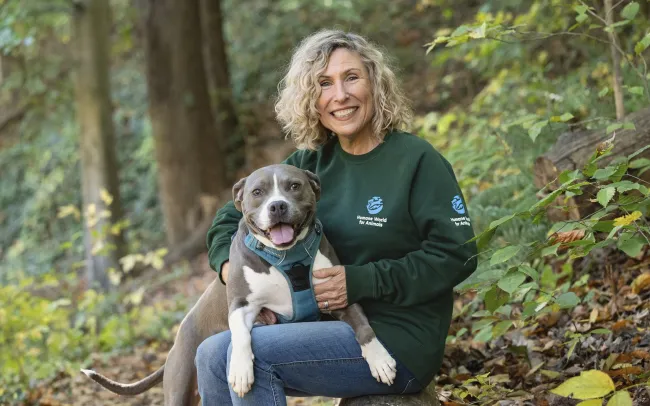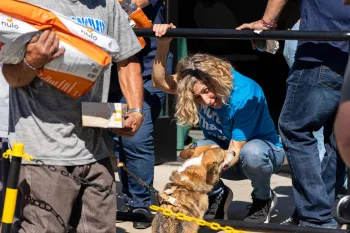
All over the world, people who love and take care of dogs, cats and other companion animals are facing a growing crisis as they struggle to access veterinary services, pet food and other animal care resources. Our vision is for everyone who wants to experience the joy of having a pet to have that opportunity. Not only does this vision benefit people, but it supports our mission to help animals by keeping pets with their loving families and removes obstacles for people who are eager to bring pets into their lives and care for community animals.
For these reasons, Humane World for Animals is committed to increasing access to pet care around the world. Our strategy looks different from country to country because these approaches are designed to be the most effective for animals and people in each region.
Here’s a glimpse at how we supported people and their pets in 2025:
United States
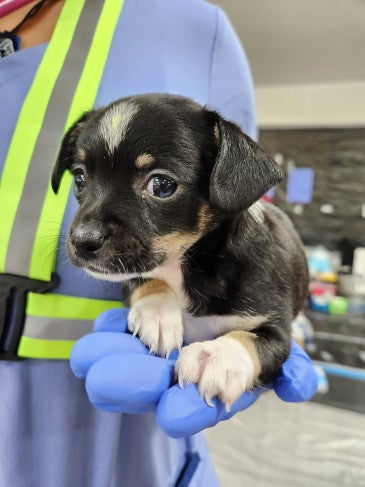
For more than two decades, through our Rural Area Veterinary Services and Pets for Life programs, we’ve provided pioneering services in access to animal care. This year, in our core communities and through our partnerships, 47,350 pets received more than 178,000 services. We also granted over $2.2 million to local organizations to establish and grow programs related to access to care.
Lauren Kloer, RAVS volunteer/Humane World for Animals
The success of our related More Than a Pet campaign has attracted growing support from corporations and foundations. In 2025, corporate partners including Smalls, ACE Cash Express, the Hartz Mountain Corporation and others contributed more than $25 million in support of our work on access to care.
The campaign also honored three extraordinary individuals this year with the Community Hero Award for their outstanding contributions to underserved communities where access to veterinary care and other pet care resources was lacking. The finalists and their nominating organizations received $30,000 in grants and prizes to support and expand their impactful work.
Through our corporate partnerships, we provided pet food and supplies to some of the most underserved communities across the country. We sent 332 truckloads of pet food and supplies to 44 states and Puerto Rico, carrying over 8.3 million pounds of pet food and 2,200 pallets of pet supplies, all valued at more than $27.5 million.
Access to pet care requires a robust network of veterinary and shelter professionals. Our Humane Veterinary Medical Alliance (HumaneVMA), RAVS and Shelter Outreach and Engagement programs offer opportunities for learning, scholarships and support for veterinary professionals, animal shelters and animal services agencies.
- RAVS provided 1,200 veterinary students and professionals training and hands-on experience through field teaching clinics and workshops.
- HumaneVMA awarded $60,000 in scholarships to five veterinary students and two veterinary technician students involved in initiatives related to access to care.
- More than 600 veterinary professionals attended HumaneVMA’s trainings that covered a variety of access-to-care topics.
- In 2025, more than 1,000 shelter and rescue professionals have been trained in the Adopters Welcome program, which identifies and removes unnecessary barriers to pet adoption, including for those who may not have access to pet resources. When shelters and rescues can provide pet food or veterinary care to adopted pets, more animals can find loving homes.
Public policy can also play a major role in increasing access to care. This year our teams, aided by our legislative team in our Animal Protection Law department, supported over 100 state bills, rules and local ordinances introduced on access to veterinary care, community cats, pet-inclusive housing and breed-specific legislation. Here are a few of those wins:
- In Ohio, a bill expanding the use of telemedicine by allowing veterinary-client-patient relationships to be established virtually took effect in September.
- Georgia established a loan repayment program for veterinarians in shelter medicine and nonprofit clinics.
- Rhode Island passed a bill that supports trap-neuter-return initiatives.
- Nevada eliminated breed-based discrimination in insurance policies for commercially owned properties and now requires certain state-funded housing to allow pets.
- Colorado now requires certain affordable housing developments to allow pets and expanded breed-ban-related insurance protections.
- The District of Columbia will now cap pet deposits and pet rent and eliminate dog breed and weight restrictions.
- Maryland now requires that rental housing providers clearly disclose pet policies online and in rental applications, improving transparency for families with pets during the affordable housing crisis.
- Prince George’s County, Maryland, repealed a decades-old ordinance that prohibited certain breeds of dogs in the county.
Access-to-care policy in the U.S. continues to grow as an area of huge potential impact on millions of people and pets.
Latin America
Across much of Latin America, access to high-quality spay/neuter services is limited. Humane World’s Latin American Veterinary Training Program is addressing this gap and provided intensive, hands-on surgical training to 50 veterinarians, technicians and students this year. Participants practice spay/neuter techniques, anesthesia and pain management protocols, and safe patient-monitoring methods that protect animal welfare even when resources are limited. After the training, the veterinarians applied their new skills to spaying and neutering animals, resulting in 3,812 sterilizations.
Mexico
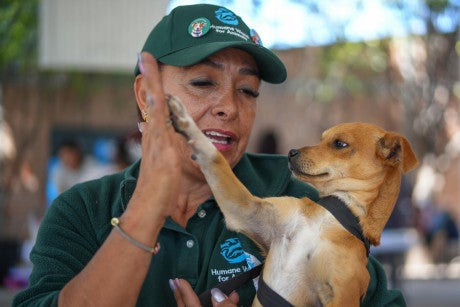
Our comprehensive companion animal program in Aguascalientes, Mexico, really took off this year, reaching close to 5,000 animals with preventive wellness services across 10 communities. At the same time, we trained nine government veterinarians and more than 60 veterinary students in humane animal handling and preventive medicine.
CITLALI FÁTIMA YAJAIRA ESPINOZA SARMIENTO/For Humane World for Animals
We provided community- and school-based education on animal behavior and how to safely interact and care for community and companion animals. As part of this program, we trained 50 teachers, reached over 4,500 students and collaborated with the department of health on an innovative community mural project to raise awareness and improve the welfare of nearly 400,000 pet dogs and cats in Aguascalientes.
Costa Rica
Our Animal-Friendly Communities program in the small but unique Caribbean town of Tortuguero, adjacent to a national park, has made substantial progress in strengthening animal welfare, public health and human-wildlife coexistence this year. Grounded in community voices rather than top-down solutions, the program co-creates strategies with a local community partner. In 2025, we provided over 315 veterinary consultations through our wellness campaigns, which are often the only point of care residents can access. We also trained 17 “animal ambassadors” in animal behavior and basic animal first aid, directly supporting and extending our clinical services. With their help, we reached over 850 residents (which is about 70% of Tortuguero’s population) with messages on healthy pet ownership and how to prevent negative interactions between companion animals and wildlife, including jaguars and sea turtles.
Chile
Our mobile veterinary clinics have become lifelines for families and their beloved animals. The team travels for hours across rugged terrain, bringing high-level care to places where such services were once unimaginable. This effort is more than logistics; it’s a partnership. Working with local leaders, we’ve built a network of trust for families and their animals. Together, we’re clearing away barriers and delivering hope—one clinic, one community at a time—with 2,700 animals receiving spay/neuter and/or wellness care this year. We also started an internship program for veterinary medicine students in Chile, hosting six interns who spent 720 hours accompanying our mobile veterinary team during field clinics, learning life-saving skills.
South Africa
Our program in Western Cape Province provided 3,000 dogs and cats with much-needed veterinary care. One of the hallmarks of this program is recruiting and training community animal welfare volunteers. These residents are key to the success of sustainable efforts to bringing improvements to animal welfare and community health in South Africa.
Romania
More than 1,500 dogs and cats in underserved communities received the veterinary care they urgently needed. The communities served have economic challenges that limit options to treat, spay/neuter or simply deworm animals. Through our direct interventions, we strengthened our partnerships with local authorities, including signing a new agreement with Neamț County Council to improve access to care in the most marginalized communities.
India
To address the growing demand for spay/neuter programs across India, we launched a comprehensive training program to build local capacity among veterinarians and animal welfare organizations. This year, a total of eight veterinarians from four organizations, and 44 animal handlers and other employees, were trained in quality surgical care, pain management and humane handling.
We responded to many calls seeking emergency treatment for community dogs or cats who had been in accidents, were unwell or in need of lifesaving surgeries. Over 1,200 dogs and cats were treated by the mobile animal clinic team and the selfless efforts of people in Hubli-Dharwad, bustling twin towns with insufficient capacity to provide such care.
—
Wherever our teams work, we see how powerful the love of animals is for individuals, families and communities. It’s a love that can bring people together to create a kinder world. I look forward to continuing this work and seeing all that we can accomplish together in the coming year.
Kitty Block is president and CEO of Humane World for Animals. Follow Kitty Block on X.