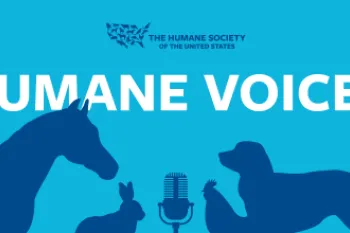
I talk to the media pretty regularly about issues and threats facing animals today and about all that we’re doing to help them. The reality of the media world, though, means that these discussions often get boiled down into 10-second sound bites! Happily, for those who want a deeper look at both the good and the bad on the animal front, we’ve got you covered. Of course, we publish our award-winning All Animals magazine for members, but for those of you stuck in cars for commutes or who love listening to audio content during your workout (or while helping animals!), we’ve recently launched our own podcast. Our team is talking to a variety of Humane Society of the United States and Humane Society International experts – on subjects from how you can help fight puppy mills to the impact of climate change on animals – and they’ll be taking on a lot more topics in the future. Suggestions for future podcast topics are welcome and can be submitted by email. I got to sit down with the producers recently and had a great time going more in-depth about our work and the animals and people who’ve really meant so much to me over the years. That episode has just been released and I hope you’ll give it a listen! You can check out the podcast here or just search ‘Humane Voices’ wherever you typically get your podcasts – we hope it’ll be an inspiration to you as you join us in creating a more humane society.
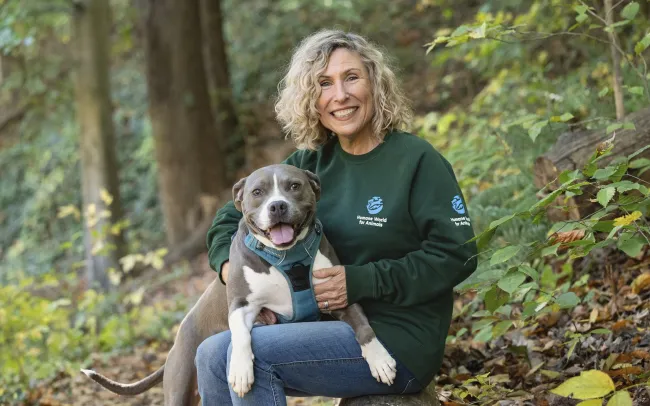
Get some “Humane Voices” in your head

Get some “Humane Voices” in your head
Date: August 6, 2019 Author(s): Kitty Block
Also of interest

Christi Gilbreth/The HSUS
In June, the U.S. Fish and Wildlife Service made a major move to implement and enforce the Big Cat Public Safety Act, issuing strong interim final regulations that are the last step in a long-fought process that closes the door on cub putting and the era of private citizens keeping big cats inappropriately.
Animal testing and researchFarm animal welfareProtecting equinesPuppy millsWildlife protectionAnimal rescue and response
The fight for public policy gains for animals at the federal level is not for the faint of heart nor the weak of spirit. Every day, in every congressional session, it’s an all-out battle to secure

Photo by iStockphoto
There is growing public demand for wildlife managers to move away from traditional, inhumane lethal control methods and towards more effective, humane, non-lethal methods -- like PZP immunocontraception -- to address conflicts and promote coexistence with wildlife like wild horses.
Protecting equines
A federal agency yesterday started removing nearly 1,000 wild horses from the Devil’s Garden territory in California’s Modoc National Forest. Animals more than 10 years old who are not adopted could

Sarkophoto/iStock.com
Not only do spring hunts make it far too easy for trophy hunters to kill vulnerable and malnourished bears, but they often leave newborn and yearling cubs orphaned—many of whom die from starvation, predation or exposure to weather.
Wildlife protectionBanning trophy hunting
Spring is a crucial time for black bears: After emerging from their dens following months in winter hibernation, many spend the first few weeks building up strength by eating mainly grasses and other